Nutrition Guide
When Is Your Baby Ready for Solids? Signs, First Foods & Allergens
By the MumNest Care Team
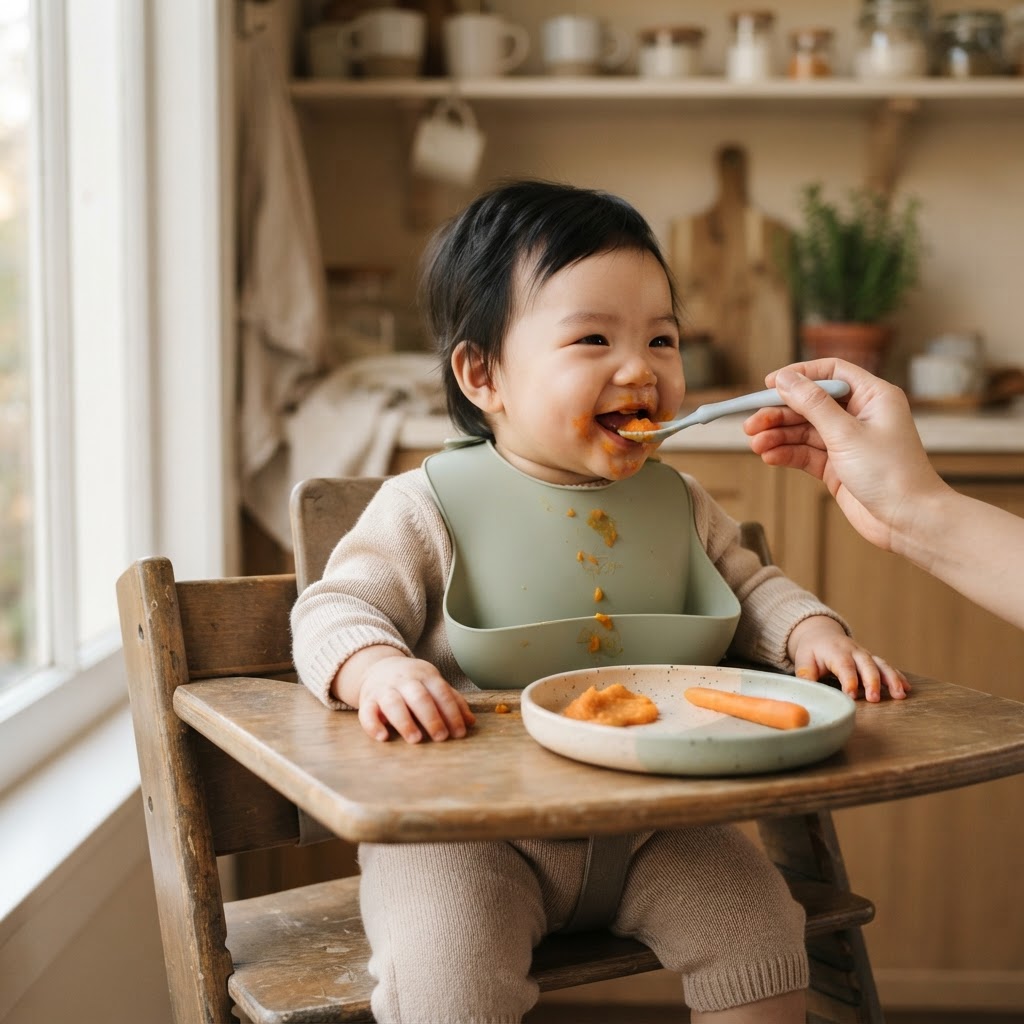
Starting solids is an exciting milestone, but readiness is about what your baby can do — not a date on the calendar. Most babies are ready at around six months, but the signs matter far more than the age. Here is what mainstream paediatric guidance says about when to begin, which foods to offer first, and how to introduce common allergens safely.
Readiness Signs — Not Just Age
Your baby's body, not the calendar, tells you when solids can begin. A baby who cannot yet sit with support or who pushes food back out of their mouth is not ready, even at six months — and a baby showing every sign at five months may be. The developmental signs below tend to appear together at around six months, which is why most guidance points to that age as a typical start.
Crucially, readiness is not about being 'advanced' — it is about safety. A baby who can sit and control their head can swallow safely; one who cannot is at higher risk of choking.
- Sitting with minimal support: Your baby can hold their head up and sit upright with only a little support — being able to sit on their own for a few minutes is a strong readiness sign. This keeps the airway safe for swallowing.
- Good head and neck control: Steady head control lets your baby lean forward or turn away, which is how they show you 'I have had enough'.
- Loss of the tongue-thrust reflex: The reflex that pushes food back out of the mouth fades at around six months. If food still comes straight back out, wait a week or two and try again.
- Showing interest in food: Watching you eat, reaching for your plate, and opening their mouth when food comes near are genuine readiness cues, not just curiosity.
- Moving food to the back of the mouth: Being able to move food from the front to the back of the mouth and swallow it (rather than gagging it forward) shows the swallow is ready.
When to Begin
Most health authorities — the AAP, WHO, and Australian infant feeding guidelines — recommend starting solids at around six months, and not before four months (17 weeks) of corrected age. Starting too early can stress an immature gut and increase the risk of allergy; starting much later can leave a baby short of iron and slow to learn chewing skills.
If your baby was born prematurely, use their corrected age (from due date, not birth date) to judge readiness, and talk to your health professional about timing. Every baby is on their own timeline.
First Foods to Offer
There is no single 'right' first food. The aim is variety, iron, and low salt and sugar. Offer one new single-ingredient food at a time for a few days so you can spot any reaction, then build up a varied menu. You can spoon-feed purees, offer soft finger foods (baby-led weaning), or a mix of both — all are valid.
- Iron-rich foods first: Babies' iron stores from pregnancy start to deplete around six months, so iron matters early. Offer pureed meat, poultry, beans, lentils, or iron-fortified baby cereal.
- Single-ingredient vegetables: Pureed or soft-cooked single veg (broccoli, carrot, zucchini, pumpkin) build a savoury palate before sweet preferences set in.
- Soft fruits: Mashed banana, avocado, or cooked pear and apple are gentle early foods.
- Full-fat and unsalted: Babies need fat for brain growth and should not have added salt or sugar; prepare family foods simply and offer a suitable texture.
Introducing Common Allergens
The guidance on allergens has changed markedly in recent years. Current evidence — including the LEAP and EAT studies and advice from allergy bodies such as ASCIA — shows that introducing common allergens early and regularly, from around six months, helps reduce the risk of food allergy rather than cause it. Delaying allergens beyond 12 months is no longer recommended.
Introduce allergens one at a time in small amounts, ideally during the day (not before a nap) so you can watch for a reaction. Once introduced, keep offering that food regularly to maintain tolerance.
- One at a time: Offer a single new allergen, wait 2–3 days, and watch for any reaction before introducing the next.
- Common allergens to introduce: Egg (well-cooked), peanut (as a smooth paste or thinned nut butter, never whole nuts), dairy, wheat, fish, sesame, and soy are the priority allergens in Australian guidance.
- Start small and build up: Begin with a tiny smear on the first day, increase the amount over a few days if there is no reaction, then keep it in regular rotation.
- High-risk families: If your baby has severe eczema or an existing allergy, or there is a strong family history, speak to your doctor before introducing allergens — they may recommend an allergy test first.
Texture & Progression
Texture matters as much as taste. Staying on smooth purees for too long can delay chewing and speech development. Move from smooth to mashed to soft lumps and finger foods over the following weeks and months as your baby's skills grow.
- Progress quickly: Most babies can handle mashed and soft lumpy textures within a few weeks of starting, so step textures up as soon as your baby manages them.
- Finger foods: Soft, easily squishable finger foods (ripe pear, steamed carrot sticks, soft cheese, toast fingers) support the pincer grasp and self-feeding.
- Responsive feeding: Let your baby decide how much to eat. Turning away, closing the mouth, or pushing the spoon away means 'I am full' — never pressure or coax extra.
Foods to Avoid or Limit
A few foods are unsafe or unsuitable in the first year. Knowing the short list lets you relax about everything else.
- Honey under 12 months: Honey can contain spores that cause infant botulism; avoid it entirely until after 12 months.
- Added salt and sugar: Baby kidneys cannot handle much salt, and sugar is unnecessary and habit-forming — keep both out of their food.
- Cow's milk as a drink: Small amounts in cooking or yoghurt are fine, but cow's milk should not replace breastmilk or formula as the main drink before 12 months.
- Choking hazards: Avoid whole grapes or cherry tomatoes, whole nuts, hard raw veg sticks, popcorn, and sausages — or modify them (e.g. halve grapes lengthways, grind nuts into a paste).
- Unpasteurised products and high-mercury fish: Skip raw or undercooked products and limit large predatory fish; choose low-mercury options instead.
Milk Is Still the Main Source
Solid food is about learning and nutrition, not replacing milk — not yet. Breastmilk or formula remains the main source of calories and nutrition until around 12 months. Think of the first months of solids as 'food under one is just for fun': exploration, iron, and texture, while milk keeps your baby fed and growing.
Continue offering breastmilk or formula on demand, and offer solids after a milk feed (or at a separate time) so iron-rich foods and new tastes are explored without displacing the nutrition that still matters most.
Conclusion
Starting solids is a journey of discovery, not a race. Watch your baby, not the calendar — when they can sit, control their head, and swallow safely, they are ready. Start with iron-rich foods, introduce allergens early and often, step up textures as skills grow, and keep milk as the main source of nutrition through the first year. Trust your baby's cues, and lean on your health professional whenever you are unsure. You are giving them a wonderful foundation for a lifetime of eating well.
Found this helpful?
Disclaimer
This article is general information only and is not medical advice, diagnosis, or treatment. Always seek the advice of your doctor or other qualified health provider with any questions about starting solids, allergens, or your baby's nutrition.
Evidence base
- American Academy of Pediatrics (AAP) — starting solids & infant nutrition
- World Health Organization (WHO) — complementary feeding guidance
- National Health and Medical Research Council (NHMRC, Australia) — infant feeding guidelines
- Australasian Society of Clinical Immunology and Allergy (ASCIA) — infant allergy prevention
- NHS (UK) — your baby's first solid foods